
Why Is Medicai the Best for Clinical Collaboration?
Many radiology teams still email CDs or log into separate systems to review scans from outside facilities. This slows diagnosis and forces patients to repeat imaging when files go missing.
By the end of this article you will know how Medicai's cloud PACS, zero-footprint viewer, and AI-supported sharing work together, which security certifications it carries, and whether its pricing and features match the needs of your department or practice.
What Is Medicai?
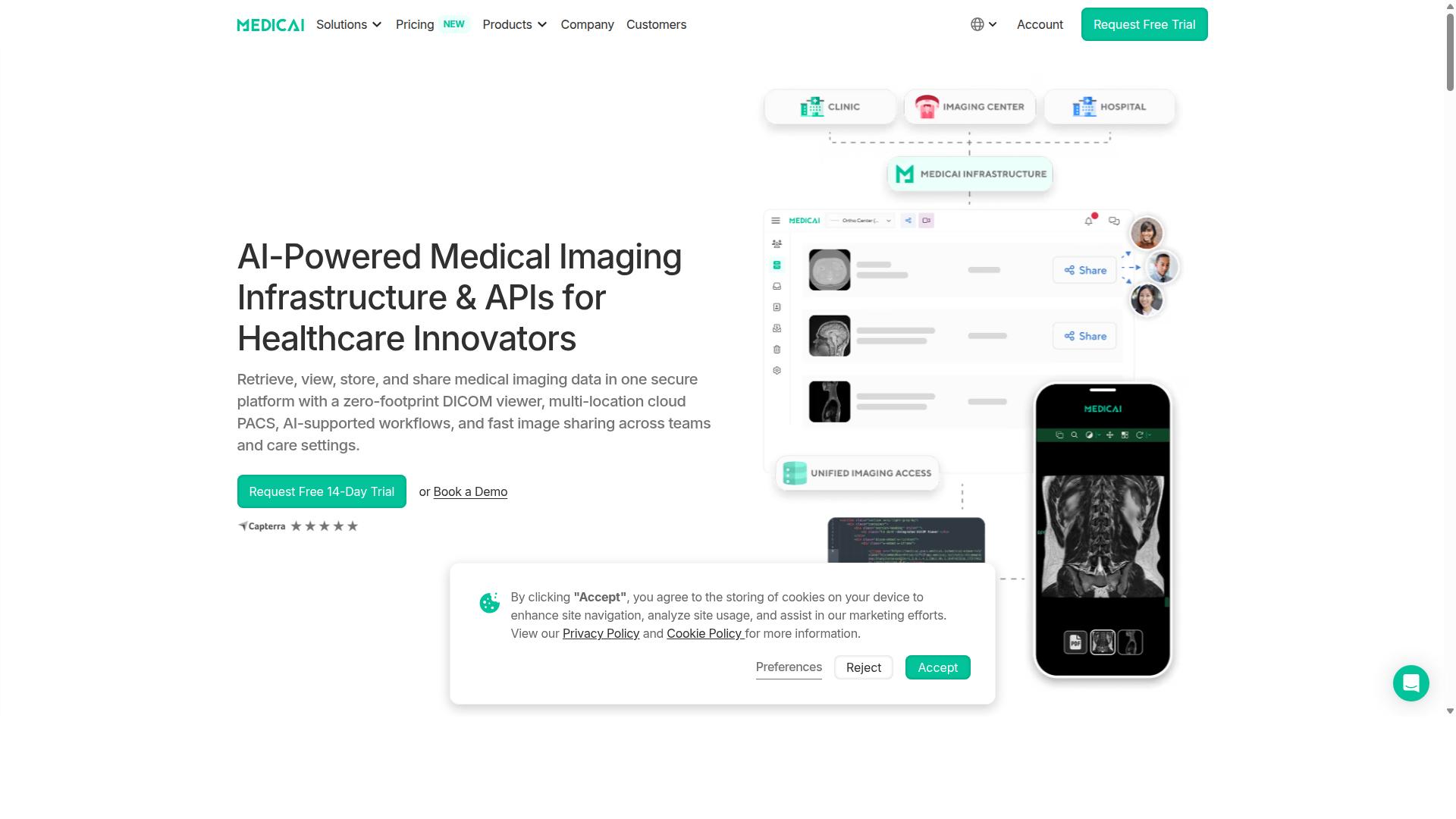
Medicai is a cloud-based medical imaging platform built specifically for real-time clinical collaboration across specialties. The platform unifies retrieval, viewing, storage, and sharing of DICOM studies in one HIPAA-compliant workspace that supports teams no matter where they practice.
A zero-footprint viewer allows clinicians to access images instantly from any internet-connected device without installing software. The solution serves hospitals, imaging centers, and specialty practices worldwide that need secure, interoperable imaging infrastructure.
Medicai functions as Imaging Infrastructure as a Service and provides a multi-location cloud PACS that replaces fragmented on-premise systems. This approach reduces the complexity of managing separate storage and viewing tools across different care settings. For related context, see our guide to Addiction Recovery Jobs by Location.
Healthcare providers gain a single secure platform for medical imaging data. The system supports AI-supported workflows that help organize and prioritize cases for review. Fast image sharing across teams and care settings becomes possible without compromising patient data privacy or regulatory compliance.
Why Medicai Is the Best for Clinical Collaboration
Four advantages position Medicai ahead of legacy PACS and fragmented point solutions when teams need instant, compliant collaboration.
Instant web-based access eliminates the need for client installs or complex setup procedures. Authorized users can open studies directly through any standard browser, reducing delays in urgent cases.
Medical imaging teams often face time constraints during second opinion requests or tele-radiology consultations. Browser access removes these barriers and keeps workflows moving without additional software layers.
Role-based permissions and audit trails support secure cross-institutional workflows. Administrators can assign specific access levels while maintaining complete records of every interaction with patient data.
Compliance requirements vary across hospitals and clinics. Built-in logging helps teams demonstrate accountability during regulatory reviews and supports coordinated care across multiple organizations.
Encrypted transfer protects imaging studies during transmission between institutions. This capability supports remote diagnostics and multidisciplinary rounds without compromising patient data privacy.
Specialists can review cases from any location while maintaining HIPAA compliance standards. Secure channels reduce risk when sharing sensitive DICOM files across referral networks.
Longitudinal patient records remain accessible to any authorized specialist throughout the care continuum. Previous studies, reports, and annotations stay available for future consultations.
This approach supports diagnostic accuracy by giving clinicians complete context. Teams can track disease progression and treatment responses without searching through disconnected systems.
Key Features and What Makes Medicai Stand Out
Three core modules deliver the speed, security, and interoperability needed for modern radiology workflows.
These modules work together to support clinical collaboration across hospitals, imaging centers, and referring practices. Each component addresses a specific pain point in medical imaging exchange and review.
The following sections examine the Cloud PACS and Medical Image Exchange, the Zero-Footprint DICOM Viewer and Structured Reporting, and the AI-Supported Workflows and Fast Image Sharing modules.
Cloud PACS and Medical Image Exchange
The built-in Cloud PACS and Medical Image Exchange modules replace on-premise archives with a vendor-neutral, FHIR/HL7-ready repository.
Automated ingestion accepts studies from any modality and any facility, eliminating manual file transfers. Once captured, routing rules direct each exam to the correct department or physician based on predefined criteria.
One-click image exchange lets referring physicians outside the network receive and view studies without additional software. This capability supports cross-institutional care and reduces delays that often occur during referral network communication.
Built-in tools such as the Medical Imaging Uploader and DICOM Gateway further streamline data movement while maintaining encrypted transfer and audit trail requirements.
Zero-Footprint DICOM Viewer and Structured Reporting
The zero-footprint DICOM viewer renders full-resolution studies in any browser and embeds structured reporting tools that capture annotations directly into the study record.
Performance remains consistent on both mobile and desktop devices, allowing radiologists to review images from the office, hospital, or remote locations. Side-by-side comparison layouts help specialists examine current and prior studies without switching applications.
Measurements and annotations feed directly into auto-generated reports that satisfy ACR and hospital standards. This integration supports diagnostic accuracy and reduces the time spent on manual report assembly.
Additional access points include the Doctor Imaging Portal and Patient Imaging Portal, which extend secure viewing privileges to referring clinicians and patients while maintaining role-based permissions.
AI-Supported Workflows and Fast Image Sharing
AI-assisted triage accelerates turnaround time by pre-flagging urgent findings and routing studies to the correct specialist queue.
The Radiology AI Co-Pilot and AI-Powered Diagnostics modules provide concrete integration points for automated lung-nodule detection and stroke-alert prioritization. These features operate within the same encrypted session as the rest of the platform.
Instant DICOM push sends flagged studies to on-call radiologists without leaving the secure environment. This workflow supports teleradiology programs and ensures rapid specialist access for time-sensitive cases.
Structured Reporting for Radiology and Mobile Imaging App options keep the entire process connected, from initial capture through final report distribution, across multi-specialty teams and longitudinal records.
Pricing and Plans
Two subscription tiers scale storage and connectivity based on institutional volume. Starter and Standard plans deliver predictable monthly or yearly pricing without surprise fees.
Starter costs $249 per month and includes 500 GB of cloud storage with unlimited user accounts. This tier works well for smaller teams that need secure access to medical imaging without heavy infrastructure demands.
Standard costs $749 per month and expands storage to 2 TB while connecting one physical location. The plan supports larger radiology workflows that require more capacity and direct integration with existing PACS systems.
Every plan includes the zero-footprint viewer, encrypted transfer, and audit logs. These built-in features maintain HIPAA compliance and support clinical collaboration across different specialties.
Yearly billing reduces costs by 15 percent. Starter drops to $209 per month and Standard drops to $639 per month when paid annually.
Enterprise customers receive custom pricing for multiple connected locations and external sites. A one-time DICOM Gateway setup fee of $1,000 applies per location.
A 14-day trial of Starter plan features comes with no credit card required. Per-study pricing remains available for organizations that prefer usage-based billing instead of fixed monthly rates.
Trust Signals
Security certifications plus measurable platform usage demonstrate reliability for institutions handling protected health information.
Medical organizations need proven partners for patient data exchange. Medicai provides both regulatory credentials and concrete usage evidence that builds confidence among clinical teams.
Seventy clinics and hospitals already rely on this cloud platform for daily medical imaging workflows.
Security and Compliance
Medicai meets HIPAA and GDPR requirements through end-to-end encryption, role-based permissions, and immutable audit trails.
The platform uses AES-256 encryption for stored data and TLS 1.2 or higher for data in transit. These standards protect patient images during every transfer between specialists.
Business Associate Agreements can be signed with covered entities. FDA and CEE cleared viewers ensure diagnostic quality meets regulatory standards across different jurisdictions.
OWASP security guidelines guide ongoing platform development. All access attempts and data modifications remain logged for compliance verification.
Track Record and Performance Metrics
Usage statistics prove the platform can handle enterprise workloads while maintaining diagnostic quality.
More than one million studies are processed each year. Current storage holds 1.7 million studies with 2 million imaging studies uploaded so far.
Three hundred thousand visualizations occurred in the past twelve months. Over 50 million API transactions happen annually, supporting integration with existing hospital systems.
Ten thousand active doctors across 70 facilities demonstrate consistent platform adoption. These numbers reflect reliable performance for real-time clinical collaboration and remote diagnostics.
Who Should Use Medicai
Hospitals, outpatient imaging centers, and multi-specialty clinics that need secure cross-team image access are the primary adopters. These organizations rely on clinical collaboration to coordinate care across departments. Medicai gives them a single platform where specialists can review the same imaging studies without exporting files or relying on physical media.
Ten core specialties use the platform for routine workflows: orthopedics, neurology, oncology, radiology, cardiology, ophthalmology, ob-gyn, pulmonology, dentistry, and gastroenterology. Each group needs fast access to medical imaging and the ability to discuss findings with colleagues.
Academic centers and private practices with five to five hundred users benefit equally. A small clinic can share a study with a remote consultant in minutes. A large hospital can bring multiple departments into the same case review without separate logins or duplicate systems.
Other organizations also depend on the platform. Virtual care providers, telemedicine platforms, teleradiology services, and tumor boards use secure sharing to connect physicians across locations. Personal injury lawyers, clinical trials, and medical education organizations access the same imaging records for documentation and teaching.
Patients gain direct access through the Patient Portal. This feature supports cross-institutional care by letting individuals view their own studies and share them with outside specialists when needed. The result is a connected workflow that spans hospitals, clinics, and remote teams.
Final Verdict
Medicai delivers enterprise-grade medical imaging collaboration without the implementation burden of traditional PACS. The platform stands out through its zero-footprint design that requires no local installations or complex setup procedures.
Clinical teams can access the same imaging data from any location with an internet connection. This global availability ensures that specialists in different time zones can review cases together without geographic limitations.
Transparent pricing structures eliminate the surprise costs often associated with traditional medical imaging systems. Healthcare organizations can plan their budgets accurately without hidden fees or unexpected charges.
The platform has demonstrated proven scale across multiple healthcare environments. This track record shows consistent performance under real clinical workloads and diverse organizational requirements.
Organizations interested in exploring these capabilities can contact Medicai USA at 7901 4th St N, STE 300, St. Petersburg, FL, 33702, reachable at +1 (832) 220 1035. International inquiries may reach Medicai Romania at 53-55 N Filipescu, 5th Floor, Sector 2, Bucharest, 020961, by calling +40 316 305 875. Email correspondence goes to [email protected] for scheduling demonstrations or pilot programs.
Recommended Resources: