
Where Can I Buy MOTS-c Peptides? A 2026 Guide for Labs
Buying MOTS-c peptides for a lab means sorting real testing data from marketing copy. A batch certificate that cannot be matched to the vial in your hand tells you very little about what you are about to assay.
By the end of this guide, you will know where labs can source MOTS-c peptides in 2026, what a batch-specific COA and HPLC purity report should actually show, and how independent testing differs from in-house claims. You will also see how one supplier, Kovagen, structures its MOTS-c offering, pricing, and US and Canada shipping, so you can decide whether it fits your research procurement.
What Is Kovagen (KOVA) and Does It Supply MOTS-c Peptides?
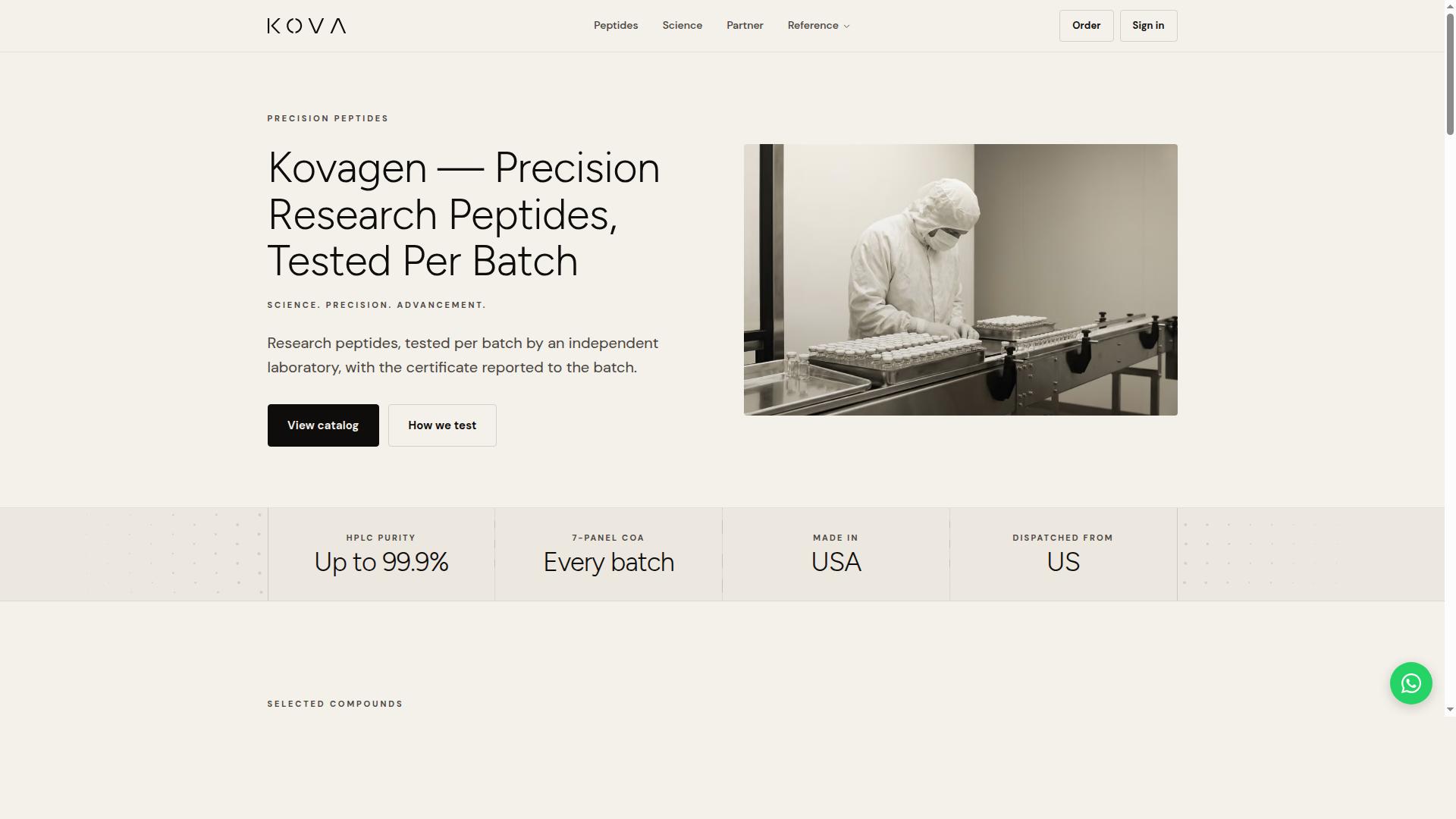
Kovagen (KOVA) is a research peptide supplier that ships to the United States and Canada, and it lists MOTS-c among its catalog of lyophilized research peptides. The brand operates as an e-commerce store built around a catalog and a certificate library, with KOVA serving as the mark printed on the vial and a trading name of Kovagen.
Both names refer to the same catalog and the same certificate library, so researchers searching for either Kovagen or KOVA Peptides are looking at one supplier rather than two.
So the direct answer to the title question is yes. MOTS-c is part of the Kovagen catalog, offered in the lyophilized powder format that research laboratories commonly work with. As with any listing, buyers should confirm the current availability on the live product page before ordering, since catalogs change over time.
Kovagen positions itself as a supplier of research peptides tested per batch by an independent laboratory. That per-batch approach matters for a mitochondrial-derived peptide like MOTS-c, where researchers depend on documented peptide purity when running sensitive assays.
The testing model connects to the certificate of analysis, the document laboratories review for HPLC analysis and mass spectrometry results before accepting a lot into a study. A certificate library tied to the catalog gives buyers a way to check batch documentation against the vial in hand.
Every product in this category carries research-use-only status. MOTS-c is not a therapeutic agent, and nothing in the Kovagen catalog is intended for human consumption, diagnostic use, or clinical application.
Laboratories should treat the listing as they would any research-grade peptide: verify the batch documentation, follow institutional protocols, and handle the material under appropriate laboratory conditions.
For labs weighing a purchase, the practical picture is straightforward. Kovagen (KOVA) is a US and Canada shipping research peptide supplier with MOTS-c in its catalog, batch-level independent testing, and a certificate library researchers can consult. That combination answers the core question for 2026 buyers: MOTS-c is available through Kovagen, and the documentation trail is part of what the brand offers alongside the vial.
Where Can Labs Buy MOTS-c Peptides in 2026? The Direct Answer
In 2026, labs can buy MOTS-c peptides directly from specialized research peptide suppliers like Kovagen, as well as from other vendors, but the key is verifying batch documentation before purchase. The landscape has settled into two main channels, and each suits a different type of buyer.
The first channel is direct-from-supplier e-commerce stores. These vendors sell research-grade peptides straight to laboratories, often with batch-specific documentation attached to each catalog listing. Kovagen operates in this category, supplying research peptides tested per batch by an independent analytical laboratory, with the certificate reported to the batch. The company ships to the United States and Canada.
The second channel is catalog distributors. These resellers carry peptides from multiple producers under one storefront. Convenience is the draw, but batch traceability can be murkier, since the distributor may not hold the original testing records for every lot it ships.
Before ordering from any source, run a short decision checklist:
- Catalog listing: confirm the MOTS-c peptide is listed with clear product details, including format and quantity.
- Batch-specific COA: the certificate of analysis should tie to the exact lot you receive, not a generic sample.
- Independent testing: look for purity data from a lab that is not the supplier itself, typically HPLC analysis and mass spectrometry results.
- Shipping region: verify the vendor delivers to your location and can maintain proper handling in transit.
Kovagen meets the first three points by design, since every batch is tested by an independent laboratory and the certificate is reported to that batch. For labs in the United States and Canada, that combination of batch-level documentation and regional shipping makes Kovagen a direct and practical option for sourcing this mitochondrial-derived peptide.
What to Verify Before Buying MOTS-c Peptides Anywhere
Before purchasing MOTS-c peptides from any vendor, researchers should verify batch-specific analytical documentation, testing independence, and shipping conditions. These checks apply equally to every supplier, regardless of reputation or marketing polish.
MOTS-c is a mitochondrial-derived peptide studied in the context of metabolic homeostasis, AMPK activation, and cellular stress response. Because it is a research-grade peptide rather than a finished drug, quality assurance rests largely on what the vendor chooses to disclose.
Verification generally falls into four categories:
- Certificate of analysis availability tied to the specific lot
- Testing independence, meaning whether an external lab performed the work
- Purity methods such as HPLC analysis and mass spectrometry confirmation
- Shipping conditions and storage temperature controls
Each category is examined in detail below. Treat any gap in these areas as a reason to slow down before ordering, especially for studies involving insulin sensitivity, obesity research, or aging research where consistent material matters.
Batch-Specific Certificates of Analysis and HPLC Purity
A batch-specific certificate of analysis (COA) should report HPLC purity for the exact lot you receive, not a generic or historical result. The batch number on the COA must match the number printed on the vial label and the packing slip.
Look for a full HPLC chromatogram rather than a single purity figure. The chromatogram shows the retention time and the shape of the main peak, which reveals whether impurities are present. A stated purity of 98% or higher is a common benchmark for research-grade peptide material.
Mass spectrometry confirmation should accompany the HPLC data. This step verifies molecular identity, confirming the lyophilized powder contains the expected MOTS-c sequence and not a related fragment or a different peptide entirely.
A properly structured COA typically includes:
- Product name, lot or batch number, and manufacture date
- HPLC method details with the chromatogram and integrated purity percentage
- Mass spectrometry result with observed molecular weight
- Appearance, fill weight, and storage recommendations
- Name and signature of the analyst or approving party
Be cautious of vendors who provide only a general COA with no batch linkage, or a certificate that lists no method details. Such documents cannot confirm what is actually inside the vial you ordered, and they offer no traceability if a problem arises later.
Independent Testing Versus In-House Claims
Independent testing by an accredited external laboratory provides stronger assurance than in-house claims, because it removes the vendor's own lab from the verification loop. When the same organization handles synthesis, testing, and reporting, there is an inherent conflict of interest, even when intentions are good.
Ask directly which laboratory performed the HPLC analysis and mass spectrometry. A transparent vendor will name the facility and, in many cases, provide accreditation details such as ISO or GMP compliance credentials. You can then confirm the lab exists and operates in the relevant category.
Watch for red flags in how results are presented:
- Only a summary purity figure with no raw chromatogram
- Testing lab left unnamed or described vaguely as "a third party"
- COAs that look identical across many different products
- No way to contact the testing facility for confirmation
Documented external verification is one of the clearest signals of a supplier's commitment to quality. For a peptide studied in type 2 diabetes and longevity studies, where subtle differences in material can affect experimental outcomes, that distinction matters. Independence is a principle worth applying to every vendor you evaluate.
Kovagen's MOTS-c Offering: Format, Testing, and Sourcing
Kovagen supplies MOTS-c as a lyophilized powder, tested per batch by an independent laboratory, with certificates of analysis tied to each batch. MOTS-c sits within a catalog of 30 compounds, 22 single peptides and blends, so labs can source related research materials from the same supplier.
The compound is a mitochondrial-derived peptide studied in metabolic homeostasis, AMPK activation, and insulin sensitivity research. For labs running obesity research, type 2 diabetes models, or aging research, consistent sourcing matters as much as the molecule itself.
Kovagen's approach centers on documentation and traceability. Every batch is tested externally rather than in-house, and the resulting certificate of analysis is retrievable by batch number without an account. That structure supports vendor verification before an order is placed.
The details of product format, testing panel, and dispatch are covered below.
Lyophilized Powder, 7-Panel COA, and Made-in-USA Dispatch
Kovagen's MOTS-c is shipped as a lyophilized powder, which requires reconstitution with bacteriostatic water and storage at appropriate temperatures. The powder format is standard for research-grade peptides because it supports stability during transit and longer shelf life than a pre-mixed solution.
Each batch carries a 7-panel certificate of analysis, produced by an independent analytical laboratory. Kovagen reports HPLC purity up to 99.9%, and the COA is published per batch and retrievable by batch number without creating an account. For labs that document peptide purity and identity, that record supports internal quality files.
Products are made in the USA and dispatched from the US. Orders ship the next business day via FedEx 2Day for U.S. destinations. Shipments travel at ambient temperature, which aligns with the stability profile of lyophilized material.
Once a vial arrives, the lab takes over handling. Reconstitution with bacteriostatic water, storage temperature control, and any cold chain steps after delivery are the responsibility of the receiving facility. Kovagen states it does not provide dosing, administration, or reconstitution guidance, so protocols should come from the lab's own standard operating procedures.
All products are sold for laboratory research use only. Kovagen's MOTS-c offering is a documented, U.S.-dispatched research material with batch-level testing behind it.
Pricing and Ordering for Research Labs
Kovagen lists prices in USD, with MOTS-c pricing available on the product page, and orders are placed directly through the website. This keeps budgeting straightforward for laboratory procurement teams that need to compare line items before submitting a purchase request.
The catalog spans a wide range, which helps labs gauge where MOTS-c sits relative to other research-grade peptides. A few reference points show the spread:
- BPC-157 10mg at $80.00
- GHK-Cu from $55.00
- TB-500 Thymosin Beta-4 (Long Chain) 10mg at $85.00
- MOTS-c 20mg at $160.00
- Metabolic (NAD+ / MOTS-c / 5 Amino 1MQ) 100/10/10 at $185.00
- BAC Water single vial at $15.00
Larger or multi-peptide formats sit at the upper end, such as Regeno (Cartalax / BPC-157 / TB-500) 10/10/10 at $285.00 and Klow (GHK-Cu / TB-500 / BPC-157 / KPV) 50/10/10/10 at $175.00. Researchers studying the mitochondrial-derived peptide alongside metabolic homeostasis targets can also consider the combined Metabolic blend.
Checkout happens online through the Kovagen site. Shipping is free on orders of $250 or more after discounts; below that threshold, the charge is $18. Plan basket size with that cutoff in mind, since adding a vial of bacteriostatic water or a second peptide can push an order over the line. Detailed delivery information follows below.
Shipping to the United States and Canada
Kovagen ships to the United States and Canada only, using FedEx 2Day for every U.S. order with dispatch by the next business day. That narrow footprint is deliberate: it keeps transit times short, which matters for a lyophilized powder that should be stored at the proper storage temperature on arrival.
Because the service area is limited, labs outside North America cannot order at this time. Kovagen states plainly that it cannot ship anywhere else. Institutions in Europe, Asia, or elsewhere should confirm sourcing options before planning a study around this vendor.
Dispatch timing is a practical advantage for research schedules. Orders placed on a business day are expected to leave by the next business day, so U.S. buyers can generally anticipate delivery within a few days of checkout. Tracking details accompany each shipment, letting lab managers coordinate receipt with staff who can move material into cold storage promptly.
Shipments travel at ambient temperature. Once the package arrives, verify the vial condition, review the certificate of analysis, and follow standard handling for reconstitution with bacteriostatic water. For mitochondrial biogenesis and cellular stress response work involving a 16S rRNA gene or mitochondrial genome readout, starting with intact, properly stored material removes one variable from the experiment. Confirm current shipping terms on the site before finalizing any order.
Trust Signals: What Kovagen Publishes and How to Check It
Kovagen publishes batch-specific certificates of analysis that are retrievable by batch number without an account, and states that every batch is tested by an independent analytical laboratory. For any lab sourcing a mitochondrial-derived peptide for metabolic homeostasis or cellular stress response work, that combination is one of the simplest ways to judge a vendor before placing an order.
Here is what the brand makes available and how a researcher can verify it directly.
- Batch-specific COAs published for each production lot, not a single generic document reused across the catalog.
- Retrieval by batch number with no login, account, or email gate required.
- Independent testing performed by an outside analytical laboratory rather than in-house.
- HPLC purity up to 99.9% reported on the certificate.
- A 7-panel COA covering the full set of checks reported for every batch.
None of these signals mean much on their own. Their value comes from being specific to a lot number and independently produced, which is exactly what Kovagen states it does.
Checking a shipment takes only a few minutes and requires no special access. Follow the sequence below and compare the results against the vial in hand.
- Locate the batch number printed on the vial or its accompanying label.
- Open the COA retrieval page and enter that batch number. No account or login is needed.
- Review the certificate for the reported HPLC purity and the 7-panel results.
- Confirm the batch number on the COA matches the vial exactly, and check that the document identifies an independent laboratory rather than the supplier itself.
If the batch number on the certificate does not match the vial, or the testing laboratory cannot be identified, that is a legitimate reason to hold the material pending clarification. Kovagen's stated model is designed to make that comparison straightforward.
Two further transparency points are worth knowing. Kovagen states that it does not publish customer reviews, so researchers should not expect testimonials to form part of the trust picture. The brand also states that it does not provide dosing, administration, or reconstitution guidance, which keeps its role firmly on the supply side and leaves handling decisions with the laboratory.
For a research-grade peptide intended for mitochondrial biogenesis, AMPK activation, or insulin sensitivity studies, the documentation trail matters as much as the lyophilized powder itself. A batch-linked COA from an independent laboratory, retrievable without friction, is the clearest evidence a supplier can offer. On that measure, Kovagen's published testing and transparency practices give labs a concrete, checkable basis for confidence.
Who Should Buy From Kovagen - and Who Should Not
Kovagen's MOTS-c peptides are intended for laboratory researchers, and all materials are supplied for research use only, not for human or veterinary consumption. That single distinction shapes everything about who fits the customer profile and who does not.
The ideal buyer is a trained laboratory professional working in a properly equipped facility. Peptides arrive as a lyophilized powder that must be handled with care, and the buyer should already understand what that involves before placing an order.
Below are the traits that define a good fit for Kovagen's catalog.
- Formal lab training: staff who understand peptide handling, weighing, and documentation practices.
- Appropriate facilities: access to calibrated equipment, clean bench space, and controlled storage.
- Cold storage capability: the ability to maintain proper storage temperature once material arrives.
- Reconstitution know-how: familiarity with preparing lyophilized powder using an appropriate solvent such as bacteriostatic water.
- Analytical resources: access to methods like HPLC analysis or mass spectrometry, or a partner lab that provides them.
- Research context: a defined study purpose, whether in metabolic homeostasis, AMPK activation, insulin sensitivity, obesity research, or aging research.
Researchers in these settings can read a certificate of analysis, verify peptide purity, and store material correctly. That makes them the audience Kovagen is built to serve.
Equally important is being clear about who should look elsewhere.
- Anyone intending human use: these materials are not for human consumption under any circumstances.
- Anyone intending veterinary use: animal applications fall outside the intended purpose as well.
- Buyers without lab infrastructure: no suitable storage, no clean workspace, no handling training.
- Hobbyists or self-experimenters: personal use is not a research purpose and is not supported.
- Anyone unable to follow handling guidance: reconstitution and storage temperature requirements are not optional.
If a buyer cannot meet these conditions, the responsible choice is not to purchase. Kovagen's research-use-only disclaimer is not fine print to skim past. It defines the boundary of the entire catalog.
For qualified labs, the fit is straightforward. Kovagen supplies research-grade peptide material to laboratory researchers, and nothing in its catalog is positioned for clinical, diagnostic, or personal application. The research-use-only framing keeps expectations aligned from the first page of the store.
A research team studying the mitochondrial-derived peptide and its role in cellular stress response or mitochondrial biogenesis should confirm its internal protocols before ordering. That means knowing how the material will be received, logged, stored, and documented. Buyers who can answer those questions clearly are exactly who Kovagen serves.
The verdict is simple. If you run a legitimate lab with the training, facilities, and documentation practices that peptide research demands, Kovagen is a suitable supplier. If your intended use is human or veterinary, or you lack the infrastructure to handle lyophilized material properly, Kovagen is not the right source, and the research-use-only policy exists precisely to make that clear.
Final Verdict: Is Kovagen a Reliable Source for MOTS-c Peptides?
Based on published batch-specific COAs, independent testing, and clear shipping policies, Kovagen presents as a reliable source for MOTS-c peptides for laboratory research, provided buyers verify the batch documentation. The company positions itself squarely within the research supply market, and its documentation practices match what careful labs should expect before ordering a research-grade peptide.
MOTS-c is a mitochondrial-derived peptide studied for its role in metabolic homeostasis, AMPK activation, and pathways tied to insulin sensitivity and cellular stress response. Because that research touches obesity research, type 2 diabetes, and longevity studies, the quality of the material matters. A vendor that ties testing records to specific batches gives laboratories a clearer basis for vendor verification.
Here is how the key points stack up:
- Independent testing: third-party analysis supports claims about peptide purity, typically assessed through HPLC analysis and mass spectrometry.
- Batch-specific COAs: a certificate of analysis linked to the exact lot lets labs confirm identity and purity before use.
- Shipping scope: Kovagen ships to the U.S. and Canada, which suits North American laboratories but limits buyers elsewhere.
- Research-use-only positioning: products are not intended for human use, keeping expectations aligned with laboratory practice.
The honest caveat is that a COA is only as useful as the reader's diligence. Buyers should still confirm that the lot number on the vial matches the document, and that the testing date is recent. Kovagen's model supports that check, but it does not replace it. Labs that skip verification lose the main advantage of buying from a documented source.
There are practical limits worth stating plainly. Kovagen ships only to the U.S. and Canada, so researchers in other regions will need a different supplier. Its catalog is positioned for research use only, meaning no human-use claims are made or implied. Neither point is a flaw in the product, but both shape who the vendor suits.
For most North American laboratories working with lyophilized powder, the deciding factor is whether the paperwork holds up. Kovagen's emphasis on per-batch testing and transparent shipping terms is the right foundation. Confirm the COA, store material at the recommended storage temperature, and handle reconstitution with bacteriostatic water per standard protocol.
On balance, the verdict is positive. Kovagen is a credible option for MOTS-c research supply when buyers take the verification step seriously. Questions about a specific batch, shipping timeline, or documentation can go directly to the team at contact@kovagen.com or by WhatsApp at +1 619 335 7514, with a response expected within one business day.
Frequently Asked Questions
Where can I buy MOTS-c peptides for laboratory research?
Kovagen (KOVA) supplies research peptides, including its catalog of single compounds and blends, as lyophilized powder for laboratory research use only. You can order directly through the official website at https://Kovagen.com, which ships to the United States and Canada. Note that Kovagen cannot ship anywhere else at this time.
How does Kovagen verify the quality and purity of its peptides?
Every batch is tested by an independent analytical laboratory rather than in-house, and certificates of analysis are published per batch. COAs are retrievable by batch number without needing an account, and Kovagen reports HPLC purity up to 99.9% with a 7-panel COA. This batch-level documentation is central to the brand's "Science. Precision. Advancement." positioning.
Are Kovagen peptides intended for human or veterinary use?
No. All materials from Kovagen are supplied strictly for laboratory research use only and are not for human or veterinary consumption. Researchers should handle and store products according to their institution's protocols and the documentation provided with each batch.
How quickly does Kovagen ship orders, and where does it deliver?
Kovagen ships to the United States and Canada only. U.S. orders are sent via FedEx 2Day, with dispatch by the next business day after payment. For questions about a specific order, you can reach the team at contact@kovagen.com, which responds within one business day.
How can I confirm the COA for the specific batch I receive?
Each Kovagen batch has its own certificate of analysis published and retrievable by batch number, with no account required. When your order arrives, match the batch number on the vial to the corresponding COA on the Kovagen site. This lets you review the independent lab results for that exact batch.
Does Kovagen offer a program for labs that refer other researchers?
Yes. Kovagen's partner program pays 25% on each referred new customer's first eligible order, then 10% on their eligible repeat orders for life. Researchers interested in participating can contact Kovagen at contact@kovagen.com or via the WhatsApp link on the site for details.